 Schlummer
Schlummer guide
Snore Recorder App for iPhone
Recording a whole night gives you eight hours of nothing with four interesting minutes buried inside it. Schlummer keeps the four minutes.
How the recorder decides what to keep
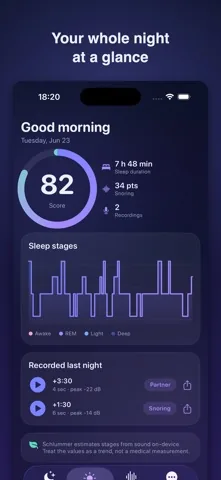
The microphone runs continuously, but nothing is written to disk while the room is quiet. Schlummer watches the level, and the moment it crosses the threshold set by your sensitivity slider, it opens an audio file, writes about eight seconds of what it is hearing and closes it again. Then it waits for the next peak.
The result is a short list rather than a recording. A typical night produces a handful of clips, each one an actual noise you made, each one long enough to recognise and short enough to send to somebody.
The sensitivity slider is the one control that matters. Turn it up and quieter sounds start triggering a clip, which is what you want in a quiet room or when you sleep alone. Turn it down when a street outside, a fan or a second person in the bed is filling the list with clips you did not make.
What one clip carries
-
When it happened
An offset into the night, shown as a plus and a time, so a clip at 1:30 means ninety minutes after you pressed start.
-
How loud it got
The peak level of the clip in decibels, which is the honest way to compare last Tuesday with tonight.
-
How long it ran
The length in seconds, normally around eight, so the numbers behind the snoring figure are traceable.
-
A tag you set
Snoring, no snoring, or partner. Tagging is how you separate your own night from whoever else is in the bed.
The snoring figure, and what it is not
Above the list sits a snoring number. It is arithmetic, not a verdict: Schlummer adds up the seconds of audio it captured, divides that by the length of the night and scales the ratio onto a range from 0 to 100. A quiet night lands near zero. A night where the recorder kept triggering climbs.
That makes it useful for comparing your own nights with each other, and useless for comparing yourself with anybody else. A loud bedroom in a city and a silent house in the country produce different numbers from identical sleepers.
A snore recorder is a microphone with a filing system. It does not detect sleep apnea, it does not measure your breathing and it does not diagnose anything. If you snore heavily, wake up gasping or are tired all day, the clips are useful to show a doctor, not a substitute for seeing one.
Hear what your nights actually sound like.

Recording is in the free version. Free, iPhone, iOS 17 or later.
Where the audio lives
In the app, on your iPhone, in a folder that belongs to Schlummer. There is no account to create, no upload step and no Schlummer server on the other end. Delete the app and the clips go with it. The only way audio leaves the phone is the share button, and only for the one clip you pick.
That share button renders the clip into a small video: a waveform drawn from the audio, the night and the score, with the original sound attached. It exists because a recording is easier to explain to a partner or to a doctor when it plays in a normal video player.
What it does not do
- It does not record the whole night. If you want a continuous file, the built in Voice Memos app is the right tool and it is free.
- It cannot tell two people apart. A microphone hears the room, so tag your partner's clips manually.
- It is not a breathing monitor. There is no apnea detection, no respiratory rate and no oxygen reading.
- It does not run in the background forever. Start the night in the app and leave it running.
Where to go next
- The step by step setup, including what to change when the list comes back empty.
- Compared with SnoreLab, if snoring is the only thing you care about.
- How the same microphone builds the sleep curve while it waits for peaks.