 Schlummer
Schlummer guide
Smart Alarm That Wakes You in Light Sleep
A gentle alarm is a trade. You give up some certainty about the exact minute and you get a wake up that arrives while you are already stirring.
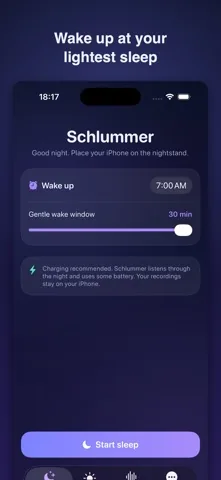
The window, in plain terms
You set a wake time. You set a window between 10 and 30 minutes. Schlummer will never wake you after the time you set, and it may wake you up to the length of the window before it.
Once the window opens, the app checks once a second what the room sounds like. The same four bands that build your sleep curve are in play here, and the alarm is waiting for one of the two shallow ones. The first second that reads as light or awake, the chime starts. If the whole window passes without such a moment, which happens on a deeply quiet night, the alarm fires at the time you set. You are never left sleeping through it.
| You set | Window opens | Alarm rings |
|---|---|---|
| 7:00, window 30 min | 6:30 | The first shallow moment after 6:30, otherwise 7:00 |
| 7:00, window 10 min | 6:50 | The first shallow moment after 6:50, otherwise 7:00 |
| 6:15, window 20 min | 5:55 | The first shallow moment after 5:55, otherwise 6:15 |
What the alarm actually plays
A soft two tone chime, built on the phone at the moment it is needed rather than loaded from a sound file. It rises and falls in a smooth envelope and repeats, so it swells into the room instead of stabbing at it. Because it is generated, it is available with no connection and it adds nothing to the size of the app.
Snooze gives you five more minutes. It is not a token gesture: the app goes back to listening during those minutes, so the second attempt is made the same way as the first.
Why it can be trusted, and where it cannot
Schlummer plays the alarm through an audio session that is allowed to run while the screen is off, and it schedules a local notification at your wake time as a second, independent path. If the app is gone by morning, the notification is still there.
That said, the honest list of things you have to do is short and it matters:
- Charge the phone. A night of listening is real work, and a dead phone has no alarm.
- Keep the ringer on. The chime plays through the normal audio path.
- Do not swipe the app away. Start the night and leave it running in front.
- Keep the window honest. A 30 minute window on a 7:00 alarm means you might be up at 6:31. If that is unacceptable, use 10 minutes or set the alarm later.
If you have a flight to catch, use the iOS Clock app as well. A smart alarm is a comfort feature. It should not be the only thing standing between you and a plane.
Set a time, set a window, and let the morning start a little softer.

The smart alarm is in the free version. iPhone, iOS 17 or later.
Does waking in light sleep really help?
The idea is old and intuitive: being pulled out of the deepest part of a cycle feels worse than being nudged when you are already close to the surface. What Schlummer can honestly claim is narrower than the idea. It knows how loud your room is, and it treats a quiet stretch as deep sleep and a restless one as shallow. That is a proxy, not a measurement of your brain, and it will sometimes be wrong.
So the fair way to describe the feature is this: it avoids ringing during the quietest, stillest part of your window, and it prefers a moment when you were already moving. Whether your morning feels better is something only a few weeks of your own experience can answer.
Where to go next
- The signal behind the decision, and what a microphone can and cannot see.
- The other end of the night, with a sleep timer that fades out after you drift off.
- Sleep Cycle compared, the app that made the wake window famous.